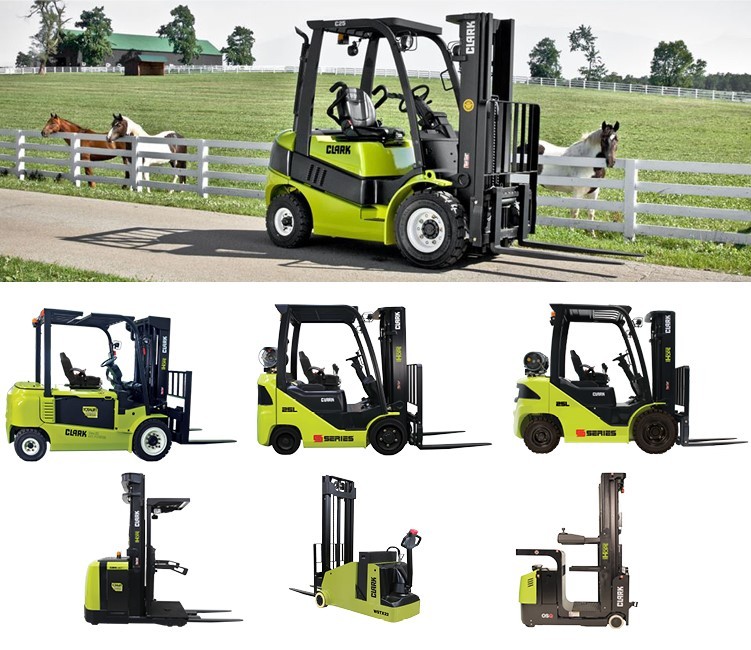



Clark Forklift History
Clark Material Handling Company is a leading supplier of equipment and machinery for material handling with over 50 years of experience provide high-quality spare parts for Clark forklifts. With their extensive experience in sourcing superior-quality equipment for the market, they are confident that the various components they provide are of the highest quality. They take pride in sourcing all the equipment you need to ensure that your Clark forklift continues to operate smoothly for many more years.
Clark Equipment Co. Ltd. was founded in 1916 and named after Eugene Clark, an engineer with the Illinois Steel Co. Ltd., which was not a major player in the machinery and equipment industry. However, what made Clark Equipment Co. Ltd. significant was the development of forklifts and their dominance in the industrial tire-wheel forklift market in the early 1950s. Clark marketed its products under the Michgan brand, establishing a reputation for the forklift industry that cannot be denied.
In 1903, Clark Equipment Co. Ltd. had its origins as the George R. Rich Manufacturing Co., serving as a subsidiary under the management of Illinois Steel Co. Ltd. The company was named after the engineer who designed the Celfor Drill to drill holes in steel rail tracks, the company needed to expand its operations to a larger factory to increase its customer base. And in 1904, the company relocated to Buchanan, Michigan. During that time, the company faced financial challenges, leading them to hire 33-year-old Eugene Clark, an employee and mechanical engineer from Illinois Steel, as a product consultant. Finally, Rich Manufacturing changed its name to Celfor Tool Co. Ltd. under Clark's management sales continued to decline consistently, with the company producing new drill bits made from tungsten steel in 1909. Clark traveled to Europe and learned that using electric furnaces improved the quality of steel casting. Believing that this process would soon begin in the United States, Clark and his managers at Celfor Tools established a second new factory called Buchanan Electric Steel Co. This factory would produce high-grade cast steel and new technologies with high quality. Ultimately, Buchanan Electric Steel became one of the two companies in the United States that produced steel wheels for the automotive industry. As the president, Clark decided to focus efforts on manufacturing durable steel wheels for trucks, replacing wooden-spoke wheels and chain-driven flatbed trucks.
Growth and Risk Diversification
In the mid-1920s, Clark owned four factories and produced drills, electric furnaces, reamers, pulleys, power transmission systems, wheels, and truck heads. As time passed, the consistent profits allowed the company to survive the economic downturn of the 1930s. The company also diversified into other products, such as aluminum railway track models for speedway work, known as automatic track-laying machines, in 1934. The prototype entered into an agreement with Clark to manufacture the undercarriage for track-laying machines and subway systems in the next twenty years. The company's truck and tractor sales also saw significant growth. In 1943, sales reached 77 million dollars, up from 11.5 million dollars four years earlier, associating the Clark name with trucks.
A multinational corporation - Clark's current manufacturing facilities are insufficient to meet demand. In 1975, Clark built a new plant in Asheville, North Carolina, becoming the first company to expand into the South, benefiting from the use of more cost-effective labor. In 1973, Clark achieved sales exceeding 1 billion dollars and established factories in the United Kingdom, Western Germany, Brazil, France, Argentina, and Australia.
Clark's contraction
During the 1980s, sales were significantly impacted by economic downturns, and the influx of lower-priced equipment from Japan had a major effect on the forklift market. The company had to face the undeniable fact that diversifying its construction equipment lineup sufficiently to compete was a failure. In 1981, Clark announced a complete withdrawal from the earth-moving and construction equipment business. Clark, recognized for inventing the forklift in 1928, decided to sell a portion of its business to Terex Corp. in 1992 as it was no longer sustainable. Clark was dissatisfied with the lack of control in the joint venture and threatened to disclose the partnership shares as a response. Volvo purchased the existing shares of Clark for $573 million and terminated the forty-year joint venture with Clark in the tire forklift business. Shortly after, Clark received another offer from Ingersoll Rand, which acquired all of Clark's remaining shares for a value of $1.4 billion.
Clark as of Today
Clark Equipment Co. Ltd. has ceased operations as it was acquired by Volvo and Ingersoll Rand. The current entity, Clark Material Handling Co. Ltd., was previously the industrial truck division of Clark Equipment Co. Ltd. In addition, Clark also offers a variety of forklifts for diverse applications. They have electric, gasoline, and diesel forklifts. Their electric forklifts are suitable for indoor use, while their gasoline and diesel forklifts are versatile for both indoor and outdoor operations.