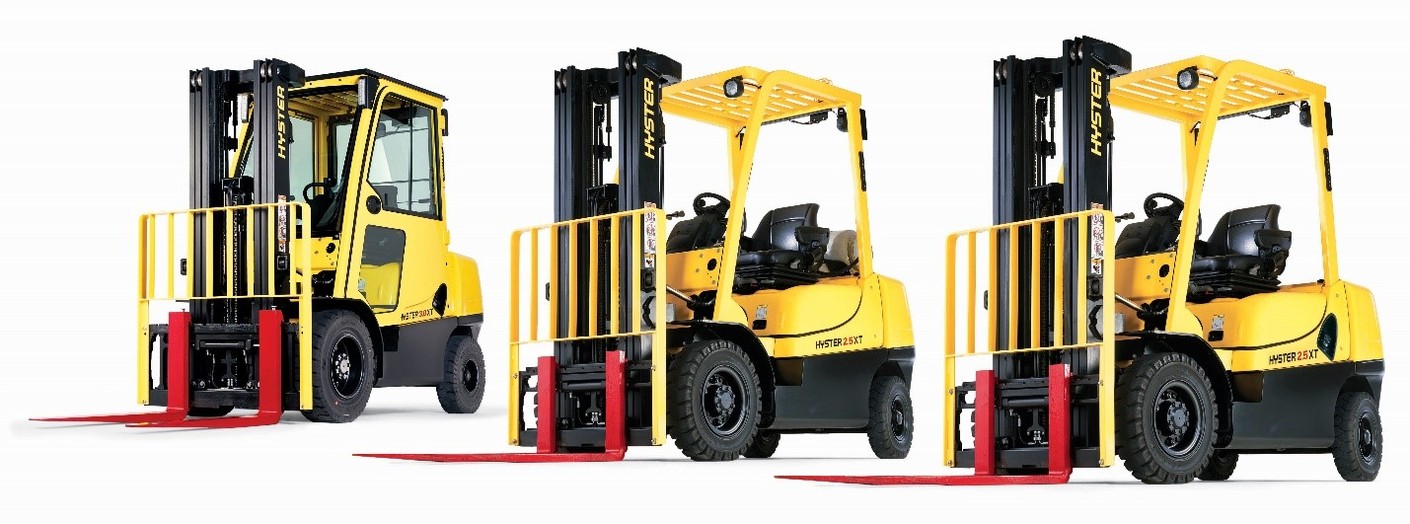



Hyster Forklift History
Hyster Company was founded in 1929 under the name Willamette-Ersted Company by Ernest G. Swigert. The company started its business as a manufacturer of winches and lifts for the timber industry in the northwest Pacific region. In 1935, the company officially changed its name to Hyster Company. The name originated from the exclamation "Hoist'er!" commonly used by lumberjacks when a log was ready to be lifted. Charles Frederick Swigert, Ernest's father was the founder of ESCO Corp., a large steel foundry. ESCO continued to be a major shareholder in Hyster. Until 1980, the company's headquarters were located in Portland, Oregon, near the region where logging and wood industries were prevalent. Hyster started as a manufacturer of lifting equipment used in the rigorous timber industry in the Northwestern Pacific region of the United States. A few years later the first forklift was invented and the Hyster® brand quickly gained a reputation for quality. Over the next eight decades, Hyster Company developed and introduced products and service networks continuously, becoming a global leader. The timeline below highlights some key events that occurred along the way. The original name of the company was Willamette-Ersted.
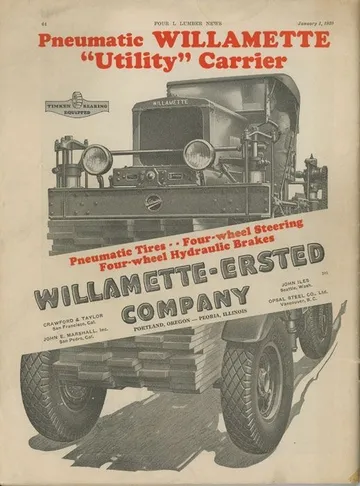
Hyster's early published posters
Hyster's early published posters
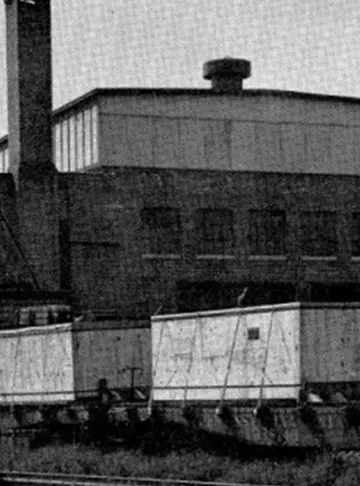
Hyster factory in Peoria Illinois
Hyster factory in Peoria Illinois
First Factory and Partners
One of the earliest and most significant initial customers was Caterpillar Tractor Company which entered into an agreement with Hyster to supply hoists for tractor-drawn logging arches. In 1936, Hyster opened a warehouse and distribution center in Caterpillar's town Peoria, Illinois. In 1940, both companies agreed to start full-scale production. The factory was located in Peoria in the Midwest which would become the central manufacturing hub for Hyster in the following decades.
After the war came to an end, Hyster attempted to reinvest in the export business to meet the growing demand for forklifts both domestically and internationally. The company opened a new factory in Danville, Illinois to serve as the main production facility for Hyster in the next 50 years.
Expansion
In 1950, Hyster became more serious about the international market. In the subsequent decades the company opened manufacturing plants and distribution centers in Scotland, Australia, Netherlands, Brazil, South Africa, and Canada. Over the next 10 years, Hyster's sales increased more than fourfold with significant growth in international markets.
Economic Recession
The prosperity that drove the forklift truck industry in the 1960s and 1970s came to a halt in the early 1980s. Economic downturns in the early 1980s had a severe impact on various industrial companies, including Hyster. However the forklift industry faced additional challenges as large Japanese automotive companies began seriously entering the American forklift market. Toyota, Mitsubishi, Nissan and Komatsu introduced forklift trucks with low prices and high efficiency to Australia in the mid-1970s. Due to these reasons Hyster's market share which was once at 30% decreased to less than half. A similar business trend occurred in the European Union in the late 1970s, resulting in a significant decline in Hyster's overall market growth. In 1982, Japanese companies gained control of more than 20% of the American market and material handling companies in different countries attempted to prevent further decline. The overall economic downturn and competition from Japan led Hyster to lose sales amounting to 422 million dollars. In 1982, the company experienced its first annual net loss, exceeding 20 million dollars.
Hyster Transformation
In 1984, Hyster was acquired by ESCO Corp a long-time private shareholder. In the late 1980s, ESCO decided to withdraw its investment by selling the company to the highest bidder. NACCO Inc., a former coal mining company, is in the process of diversifying its risk and has acquired Yale Materials Handling Corp, a competitor of Hyster. In May 1989, NACCO acquired Hyster's business for $620 million, along with an agreement to assume the company's debt of $80 million. The operations of Hyster merged with Yale, forming Hyster-Yale, and became the top forklift manufacturer in North America. The management of both companies separated in 1995 under NACCO and Hyster has operated independently since then.
At present, Hyster is a leading manufacturer of equipment and material handling solutions worldwide dedicated to sustainable growth. Hyster offers forklifts, pallet jacks, container handlers, and other material handling equipment for sale or rent. Looking into the future, Hyster is dedicated to continuous innovation in the material handling industry. With a focus on developing new technologies to enhance manufacturing efficiency and safety, Hyster is poised to lead the forklift industry in the years to come.
How To Choose The Right Parts For a Hyster Forklift
When choosing parts for your Hyster forklift, there are some things to consider. First and foremost ensure that the selected parts are compatible with the specific model of your Hyster forklift. Not all parts are manufactured equally and not every part is universally compatible with all models of Hyster forklifts. If you're unsure about compatible parts for your model it's advisable to consult with an authorized Hyster dealer in your area or a certified Hyster service center. In addition to compatibility consider the condition of the parts. Remember that forklifts are durable machines built to withstand heavy use. You don't necessarily have to opt for the newest or most expensive parts focus on finding reliable replacement parts that are in good condition and can endure the rigors of your work. Personal preferences should also play a role when selecting replacement parts for your Hyster forklift. Not everyone has the same needs, and not everyone will be satisfied with the same type of spare parts. The important thing is to choose the parts that you are satisfied with and that meet your requirements. When considering these factors, you can be confident that you are selecting the right spare parts for your Hyster forklift. With the right parts, you can ensure that your forklift operates smoothly and efficiently for many years to come.
When Should You Replace Hyster Parts
The answer to this question depends on several factors, such as the frequency of forklift usage, the type of working environment, and the maintenance regimen the forklift undergoes. Forklifts used daily in a warehouse setting, for example, may require more frequent part replacements compared to those used sporadically or stored indoors. When deciding when to replace forklift parts, it's crucial to avoid mistakes by being cautious and opting for quick replacements when needed. Another factor to consider is the type of environmental conditions in which the forklift is used. If it operates in a dusty or dirty environment, parts may need more frequent replacements compared to usage in a clean environment Ultimately, the type of maintenance for Hyster forklifts will impact the frequency of part replacements. Forklifts that undergo regular servicing and maintenance tend to have longer-lasting components than those that are not maintained. If you are unsure about when to replace parts on your forklift, it's advisable to consult with experienced mechanics. They can help you determine the optimal timing for part replacements based on the factors mentioned above. Timely replacement of forklift parts is crucial for maintaining your forklift and keeping it in good working condition. By addressing these replacements when necessary, you can avoid costly repairs.